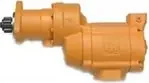
Ingersoll Rand literature · Technical paper
Starting and Operation of Diesel Engines at -25 °F: Application of Pneumatic Cranking Methods (Ingersoll Rand Form 6918)
A 1989 Ingersoll Rand Engine Starting Systems technical paper on cranking diesel engines with air starters at -25 °F. It explains why cold makes diesel starting harder, reviews how a pre-engaged air start system works, and walks through how cold affects the reservoir, check valve, control valve, relay valve and starter lubrication. It then reports a cold-cell test of a heavy-duty diesel with an IR 150BM starter, with rpm graphs, a data printout and setup photographs.
Document at a Glance
- Publisher
- Ingersoll Rand
- Document type
- Technical paper
- Form / number
- Form 6918, No. 03537610, May 1989
- Language
- English
- Pages
- 16
- File
- PDF, 14.9 MB
What's in This Document
| Section | Pages | What it covers |
|---|---|---|
| Abstract and Introduction | 1 | Sets out the cold-starting problem and the paper's purpose. |
| Cold Weather Cranking Conditions and Adversities | 1-2 | Combustion heat, chamber wall heat loss and oil viscosity effects at -25 °F. |
| Air Start System Review | 2-3 | Four-step description of a pre-engaged air start system with schematics. |
| Temperature Variances and Their Negative Effects on the Air Starting System | 4-6 | Sealing, condensation and icing, the three system valves, and lubrication needs at low temperature. |
| Test Objective and Test Equipment | 7 | Engine, starting system components and data acquisition used in the cold test. |
| Test Arrangement, Procedure, Objectives and Results | 8 | Instrument locations, the five-step procedure, four test definitions and results. |
| Graphs Showing RPM vs Time in Seconds | 9 | Chart-recorder traces for Tests 1, 2/3 and 4. |
| Summary and Conclusion | 10 | Comparison of warm and cold readings and the paper's conclusions on cold starting aids. |
| Appendix A | 11-12 | Data printout of Test No. 3, cycle counts 0-7. |
| Appendix B | 13-15 | Photographs of the instrumented starter, reservoirs, cold room and recording equipment. |
Key Specifications and Data
| Item | Value | Page |
|---|---|---|
| Test temperature | -25 °F, components cold-soaked 24 hours | 8 |
| Reservoir charge pressure | 120 psi | 8 |
| Air tanks | Two 55 gal tanks in series with a hand-operated globe valve | 7 |
| Test engine | 6-cylinder turbocharged diesel, 855 CID, 103-tooth ring gear | 7 |
| Engine idle speed | 575-650 rpm | 7 |
| Starter gear ratio | 3.47:1 | 7 |
| Starter pinion | 11T cut on 12T blank, 6/8 D.P., 20° P.A. | 7 |
| Relay valve connections | 1-1/4 in NPT | 7 |
| Combustion temperature rise needed | 645 °F at 80 °F ambient vs 750 °F at -25 °F (725 °F combustion point) | 1 |
| Warm test (75 °F) result | 226 rpm max; 6.8 s above 100 rpm; 9 s total crank | 8 |
| Cold test (-25 °F) result | 95 rpm max; 3.2 s above 50 rpm; 5 s total crank | 8 |
| Cold test with ether | Ignition at 80 rpm after a 3 s crank | 8 |
| Data sampling | 7 channels scanned 5 times per second | 7 |
Cranking test results
| Test | Condition | Max rpm | Time above threshold | Total crank time |
|---|---|---|---|---|
| 1 | 75 °F, no-start mode, one 55 gal tank | 226 | 6.8 s above 100 rpm | 9 s |
| 2 | -25 °F soak 24 h, no-start mode, one 55 gal tank | 95 | 3.2 s above 50 rpm | 5 s |
| 3 | As test 2, start mode | 95 | 3.2 s above 50 rpm | 5 s |
| 4 | As tests 2 and 3 plus 8 s ether fumigation | ignition at 80 | - | 3 s crank |
Warm vs cold sample readings
| Reading | Test 1 at 75 °F | Test 2 at -25 °F | ||
|---|---|---|---|---|
| Pressure | 96 | 80 | 96 | 82 |
| Sequence No. | 30 | 34 | 6 | 52 |
| Engine rpm | 198 | 226 | 83 | 38 |
Models Covered
Model codes as printed in the document. Linked codes go to the matching Ingersoll Rand starter in our catalog.
150BMPE78RH-6 SRV125
Service Kits and Part Numbers
| Part number | Description | Page |
|---|---|---|
| 150BMPE78RH-6 | Starter model used in the test (serial RMJ15163) | 7 |
| SRV125 | Relay valve with 1-1/4 in NPT connections | 7 |
| SMB-618 | Control valve | 7 |
| 55RS | Air tank, 55 gal capacity | 7 |
| 150BMP-1054 | Check valve | 7 |
Confirm part numbers against the serial and model plate of your starter. For any part not listed in our catalog, send us the number.
How a pre-engaged air start system cranks the engine (Overview)
- A dedicated air reservoir, isolated from its supply by a check valve, stores the starting energy.
- The operator presses a remotely mounted push-type starter control valve.
- The air signal goes to the starter drive housing piston, which engages the pinion with the ring gear before the motor turns.
- Once engaged, the signal passes on to the relay valve on the reservoir, which opens and sends main air to the starter motor.
An outline only. Follow the full procedure, torque values and safety warnings in the document (from page 2).
Cold-cell test procedure (Overview)
- Charge the air reservoir to 120 psi.
- Set the globe valve for one- or two-reservoir operation.
- Start the recording equipment.
- Activate and hold the control valve.
- When cranking stops or the engine starts, release the control valve and stop recording.
An outline only. Follow the full procedure, torque values and safety warnings in the document (from page 8).
Frequently Asked Questions
Can a diesel engine be air started at -25 °F?
In Ingersoll Rand's cold-cell test, a heavy-duty diesel cold-soaked at -25 °F started only with an air start system plus an ether cold start kit; without ether the engine reached just 95 rpm.
Why does cold weather slow air starter cranking?
The paper explains that engine oil thickens as temperature drops, sharply raising the torque needed to crank, while more heat is lost into the combustion chamber walls.
Why is dry air important for an air starting system in winter?
Condensation turns to ice below zero and can make the system's valves stick open or closed, so the paper stresses supplying clean, dry air.
Which valves in an air start system are affected by cold?
All three: the reservoir check valve, the remote control valve and the relay valve. Their lubricants must still let seats and plungers move freely and seal at -25 °F.
What sealant does the paper recommend for air start system joints?
A liquid Teflon pipe sealant on threaded joints and mounted valves, to keep reservoir leakage to a minimum.
Need the parts or the starter in this document? Send the model number from your starter's plate and we will confirm the right Ingersoll Rand part or replacement.
Source: Ingersoll Rand, Form 6918, No. 03537610, May 1989. Summary and tables prepared by AirStartersDirect.com, an authorized Ingersoll Rand air starter distributor; the PDF is the authoritative version. Page numbers refer to the PDF file. Reviewed October 2026.
Turbine Air Starter Category Links

Updated turbine starter from Ingersoll Rand for engines from 16-95 liters.

Powerful 70 hp turbine motor offers best-in-class performance in the harshest conditions!

NEWEST MODEL! Unlocks unprecedented productivity for engines ranging from 15 up to 150 liters!

Industrial duty air starter for engines 5 to 60 liters (Diesel). Commonly used in marine, trucking, transit, and oil & gas applications.

Industrial duty air starter for engines 16 to 80 liters (Diesel). Commonly used in mining and marine applications.

For engine displacement of: Diesel 16 to 320 liters Industry applications for the ST700 and ST900 Series starters - oil and gas, marine, power-gen, and transportation.

Industrial duty air starter for engines 5 to 60 liters (Diesel). Commonly used in marine, trucking, transit, and oil & gas applications.
Vane Air Starter, Gas Turbine Starter, and Engine Barring Motor Category Links

NEW! One Size fits engines up to 10+ liters.

For Diesel engines 8 - 32 liters.

Sealed for Gas applications.

For Diesel engines 3 to 20 liters.

For Diesel engines 16 - 320 liters.

For service work on diesel engines.
Questions? Need Help Finding The Right air Starter? Use Our Fast Response Form Below
